






Chondroitin Sulfate: The Dual-Action Compound That Builds Cartilage and Blocks the Enzymes That Destroy It
Chondroitin sulfate is a sulfated glycosaminoglycan that serves as the primary structural component of aggrecan — the cartilage proteoglycan responsible for joint tissue's compressive resilience — while simultaneously functioning as an active inhibitor of matrix metalloproteinases, the enzymes responsible for degrading cartilage collagen during inflammatory joint conditions. This dual mechanism, structural building material on one hand and active enzymatic protection on the other, distinguishes chondroitin from glucosamine's more purely synthetic-precursor role, and it is the basis for chondroitin's documented effects on both cartilage volume preservation and joint space maintenance in long-term randomized controlled trials.
While glucosamine and chondroitin are almost always discussed together — and for good reason, given their complementary mechanisms — chondroitin's specific contribution deserves its own examination. Its capacity to actively inhibit the enzymes that break cartilage down is a meaningfully different kind of action than simply providing raw material for cartilage synthesis, and understanding this distinction clarifies why the combination of the two compounds outperforms either alone in the clinical research.

Chondroitin's Structural Role: Building the Water-Trapping Matrix
Chondroitin sulfate is not merely a precursor that gets converted into something else — it is itself one of the primary glycosaminoglycan chains that physically compose the aggrecan proteoglycan molecule, the dominant structural component of articular cartilage. Aggrecan's protein core is studded with numerous chondroitin sulfate chains (along with keratan sulfate chains), and the dense negative charge created by these sulfated chains is what gives cartilage its remarkable capacity to attract and bind water under compressive load — the biomechanical property responsible for cartilage's shock-absorbing, load-distributing function during walking, running, and weight-bearing activity generally.
When cartilage degrades — whether through age-related decline, mechanical overuse, or active inflammatory disease — chondroitin sulfate content decreases as part of the broader loss of aggrecan integrity. Supplementing chondroitin sulfate provides additional structural building material, supporting chondrocytes' capacity to maintain and rebuild this water-retaining matrix.
Chondroitin's Protective Role: Inhibiting Matrix Metalloproteinases
This is the mechanism that most clearly distinguishes chondroitin from glucosamine, and it deserves particular attention because it addresses an entirely different biological process than cartilage synthesis.
Matrix metalloproteinases (MMPs) are a family of zinc-dependent enzymes responsible for degrading the protein components of cartilage, including type II collagen and aggrecan itself. In healthy joints, MMP activity is tightly regulated and balanced by natural inhibitors. In inflamed or mechanically stressed joints, however, pro-inflammatory cytokines (particularly IL-1β and TNF-α) stimulate excessive MMP production — most significantly MMP-3 (stromelysin-1) and MMP-13 (collagenase-3) — leading to accelerated cartilage breakdown that outpaces the chondrocytes' synthetic capacity to repair it.
Chondroitin sulfate has been shown to inhibit MMP-3 and MMP-13 activity directly, providing a brake on this enzymatic degradation process. This is a fundamentally different mode of action than glucosamine's substrate-providing role: where glucosamine supports the building side of the cartilage equation, chondroitin's MMP-inhibitory activity directly slows the demolition side. A compound that does both — supports synthesis and inhibits degradation — addresses the cartilage health equation from two directions simultaneously, which is precisely the dual role chondroitin occupies.
The Clinical Evidence
The LEGS Trial (2014, Annals of the Rheumatic Diseases): The Long-Term Evaluation of Glucosamine Sulfate trial examined chondroitin sulfate (800 mg daily) alongside glucosamine in 605 patients with knee osteoarthritis over a two-year period. Chondroitin sulfate was found to significantly reduce cartilage volume loss compared to placebo — a direct structural measure assessed through MRI imaging — providing independent confirmation of chondroitin's cartilage-preserving effect beyond symptom management alone.
The GAIT Trial Subgroup Analysis: As discussed in the context of glucosamine, the NIH-funded GAIT trial found the glucosamine-plus-chondroitin combination produced the strongest response (79.2%) in the subgroup of patients with moderate-to-severe knee pain, a margin comparable to the prescription COX-2 inhibitor comparison arm of the same trial.
Systematic Reviews and Meta-Analyses: Multiple independent meta-analyses of chondroitin sulfate trials have found consistent, modest-to-moderate improvements in pain and function scores compared to placebo, with the most consistent effects observed in trials using pharmaceutical-grade, well-characterized chondroitin sulfate preparations rather than lower-purity commercial extracts — a pattern that mirrors the standardization-dependent findings discussed in connection with several other botanical and nutraceutical joint compounds.
Why Source and Purity Matter for Chondroitin Specifically
Chondroitin sulfate is most commonly derived from animal cartilage sources, including bovine (cow) tracheal cartilage and shark cartilage, through an extraction and purification process. The molecular weight and purity of the resulting chondroitin sulfate can vary considerably across manufacturers and extraction methods — variability that has been specifically implicated in some of the inconsistency seen across the broader (non-pharmaceutical-grade) commercial chondroitin market. Lower-molecular-weight, less pure chondroitin preparations may have reduced bioavailability and less reliable biological activity compared to the higher-purity, pharmaceutical-grade preparations used in the most consistently positive clinical trials.
This is a meaningful consideration for anyone evaluating chondroitin-containing products: a label listing "chondroitin sulfate" without further detail about source, purity, or molecular weight standardization provides less assurance of replicating the clinical trial results than a product specifying these details, ideally backed by third-party testing.
Why Chondroitin Works Best Alongside Glucosamine
The complementary mechanisms described above — glucosamine as substrate precursor, chondroitin as both structural component and MMP inhibitor — explain why the clinical evidence consistently favors the combination over either compound alone, particularly in patients with more advanced joint symptoms. This complementarity also extends to the broader formula context: anti-inflammatory compounds like Boswellia and turmeric address the upstream cytokine signaling (IL-1β, TNF-α) that drives the excessive MMP production chondroitin is working to inhibit downstream — meaning a comprehensive formula addresses the inflammatory cascade at multiple points simultaneously rather than relying on chondroitin's MMP inhibition as the sole defense against degradation.
Dosing and Timeline
Clinical trials demonstrating structural and symptomatic benefit have generally used chondroitin sulfate doses between 800 mg and 1,200 mg daily. As with glucosamine, chondroitin's mechanism involves supporting an ongoing biological process rather than producing acute effects, meaning meaningful symptomatic benefit typically develops over 6 to 8 weeks of consistent use, with structural benefits (cartilage volume preservation, joint space maintenance) requiring sustained use over many months to years to become measurable.
Safety Considerations
Chondroitin sulfate has a favorable long-term safety profile across the available clinical trial literature, with mild gastrointestinal upset being the most commonly reported side effect in a small minority of users. Because chondroitin is most commonly sourced from animal cartilage (bovine or shark), individuals with relevant allergies or dietary restrictions should confirm sourcing with the manufacturer. Chondroitin's structural similarity to heparin (an anticoagulant) has led to theoretical questions about interaction with blood-thinning medications, though clinically significant interactions have not been well-established in the research literature; individuals on anticoagulant therapy may still wish to mention chondroitin use to their healthcare provider as a precaution.
Clear Wellness 360 Products with Chondroitin Sulfate
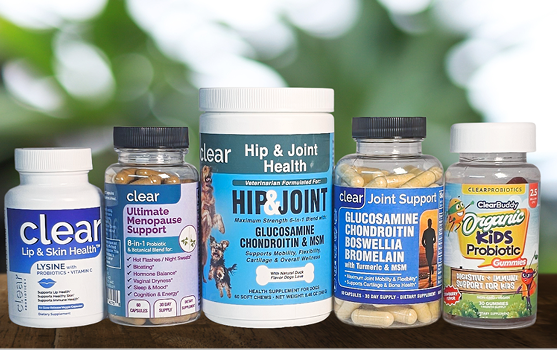
Clear Joint Support combines Chondroitin Sulfate with Glucosamine Sulfate Potassium, MSM, Turmeric, Boswellia, Quercetin, Bromelain, and L-Methionine — pairing chondroitin's structural and MMP-inhibitory dual mechanism with glucosamine's synthetic precursor role and the formula's broader anti-inflammatory compounds.
Glossary of Key Terms
Matrix Metalloproteinases (MMPs) — A family of zinc-dependent enzymes responsible for degrading extracellular matrix proteins, including cartilage collagen and proteoglycans. MMP-3 and MMP-13 are particularly destructive in osteoarthritis, where pro-inflammatory cytokine signaling drives their excessive production. Chondroitin sulfate inhibits both enzymes directly.
Aggrecan — The dominant proteoglycan in articular cartilage, composed of a protein core studded with chondroitin sulfate and keratan sulfate glycosaminoglycan chains. The negative charge density of these chains gives aggrecan its water-attracting, compression-resisting biomechanical function.
Anabolic and Catabolic Activity — Anabolic refers to building or synthesizing processes (cartilage matrix construction); catabolic refers to breaking-down or degrading processes (enzymatic cartilage destruction). Chondroitin sulfate is sometimes described as having both anabolic (structural building material) and anti-catabolic (MMP inhibition) activity simultaneously.
Cartilage Volume — A structural measure of total cartilage tissue quantity within a joint, typically assessed through MRI imaging in clinical research. Cartilage volume loss over time is a direct indicator of disease progression, distinct from but complementary to joint space narrowing as measured on X-ray.
Molecular Weight (in chondroitin context) — A measure of the size of the chondroitin sulfate polymer chains in a given preparation. Molecular weight and purity can vary considerably across manufacturers and extraction methods, with variability implicated in some of the inconsistency seen in lower-purity commercial chondroitin products compared to pharmaceutical-grade preparations.
Frequently Asked Questions
Q: What does chondroitin sulfate actually do that glucosamine doesn't?
While both compounds support cartilage health, they work through different and complementary mechanisms. Glucosamine primarily serves as a precursor substance that chondrocytes use to synthesize new glycosaminoglycan chains. Chondroitin sulfate is itself a structural glycosaminoglycan component of aggrecan, and it additionally inhibits matrix metalloproteinases (MMP-3 and MMP-13) — the enzymes responsible for actively degrading cartilage collagen. This means chondroitin addresses both the building and the demolition sides of cartilage health, while glucosamine primarily addresses the building side.
Q: Is there research showing chondroitin sulfate preserves cartilage, not just relieves pain?
Yes. The LEGS trial, a two-year randomized controlled study published in the Annals of the Rheumatic Diseases, found that chondroitin sulfate significantly reduced cartilage volume loss compared to placebo, as measured directly through MRI imaging — a structural endpoint distinct from self-reported pain or function scores.
Q: Why does chondroitin sulfate quality vary so much between products?
Chondroitin sulfate is typically extracted from animal cartilage sources (commonly bovine or shark), and the molecular weight and purity of the resulting product can vary considerably depending on the extraction and purification method used. Lower-purity, lower-molecular-weight preparations may have reduced bioavailability and less reliable biological activity than the pharmaceutical-grade preparations used in the most consistently positive clinical trials, which is why source transparency and third-party testing matter when evaluating chondroitin-containing products.
Q: What dose of chondroitin sulfate is used in clinical research?
Most clinical trials demonstrating structural and symptomatic benefit have used doses between 800 mg and 1,200 mg daily. As with most compounds in this category, chondroitin's mechanism is gradual and cumulative rather than acute, so meaningful benefit typically requires several weeks to months of consistent daily use.
Q: Can I take chondroitin sulfate if I'm on blood thinners?
Chondroitin's structural similarity to heparin (an anticoagulant medication) has raised theoretical interaction questions, though clinically significant interactions have not been well-established in the available research. Individuals on anticoagulant or antiplatelet therapy should mention chondroitin supplementation to their healthcare provider as a precautionary step.
These statements have not been evaluated by the Food and Drug Administration. This product is not intended to diagnose, treat, cure, or prevent any disease.
References: Fransen M et al. (2015). Glucosamine and chondroitin for knee osteoarthritis: a randomised, placebo-controlled trial. Annals of the Rheumatic Diseases, 74(5), 851–858. | Clegg DO et al. (2006). Glucosamine, chondroitin sulfate, and the two in combination for painful knee osteoarthritis. New England Journal of Medicine, 354(8), 795–808. | Bana G et al. (2015). Chondroitin sulfate and structural modification in osteoarthritis. Current Rheumatology Reports. | Mathieu P (2009). Mode of chondroitin sulfate action in osteoarthritis: matrix metalloproteinase inhibition. International Journal of Rheumatic Diseases.